
There is a question almost nobody asks about autonomous AI agents, and it is the only question that matters once they touch real work:
When one of them says "done" — how do you know?
Not how do you hope. How do you know.
The entire agent economy is built on avoiding this question. The pitch is always the same: autonomous AI that works while you sleep. The demo shows an agent booking a flight or filing a ticket, a green checkmark appears, and the audience applauds. Nobody in the room asks who checked the work, because the honest answer would ruin the demo: nobody did. The checkmark is the agent grading its own homework.
Prompting is not management
The industry's answer to unreliable agents has been to prompt harder. Longer system prompts. More elaborate instructions. Chains of prompts prompting other prompts. This is treating a management problem as a phrasing problem, and it fails for the same reason it would fail with people: you cannot instruction your way to trustworthiness. No employment contract, however detailed, has ever made an unsupervised new hire reliable on day one. What makes people reliable is a structure around them — oversight that relaxes as evidence accumulates.
We have several thousand years of institutional knowledge about getting good work out of intelligent, fallible workers. It is called management, and almost none of it has been applied to AI agents.
Consider what any functioning organization does with a new hire. They are recruited for a defined role, not asked to do everything. They start supervised — their early work is reviewed before it counts. They earn autonomy gradually, decision by decision, on a record their manager can inspect. And when they claim something is finished, the claim is checked against reality, because organizations that stop verifying eventually collapse under the weight of comfortable fictions.
None of this is bureaucracy. It is how trust is manufactured out of uncertainty. And it is exactly the structure AI agents have been deployed without.
What hiring an agent actually means
Take the metaphor seriously and the design writes itself.
An agent is recruited for a role. A researcher, a planner, an executor, a coordinator — with a name, a defined expertise, and a scope. Role definition is not cosmetic: an agent that can do anything is an agent whose failures can come from anywhere.
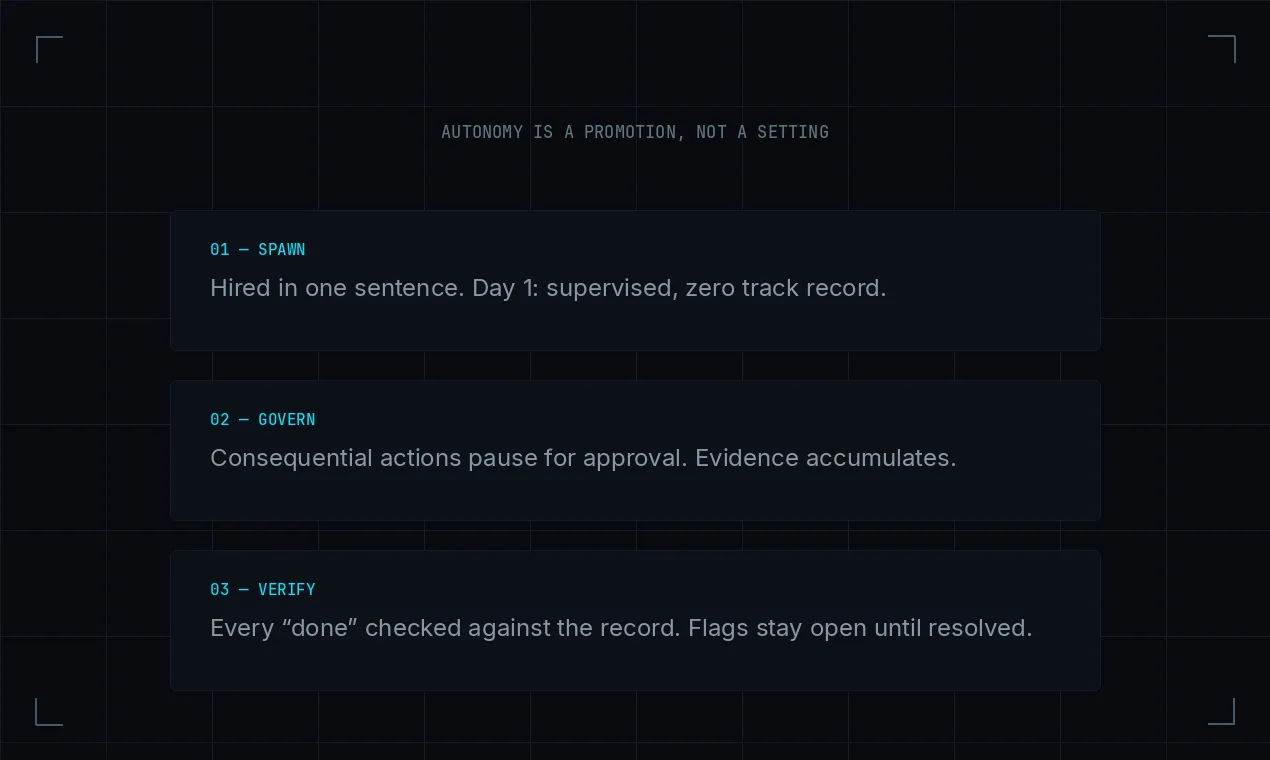
An agent starts supervised. Day one, zero track record, every consequential action pauses for approval. This is not distrust of the technology; it is the honest starting position for any worker without a history. The interesting question was never whether to supervise a new agent — it is how the agent gets out of supervision.
Autonomy is a promotion, not a setting. This is the line that separates governed systems from everything else on the market. In most agent platforms, autonomy is a toggle: the human switches it on, usually on day one, usually because the toggle was there. In a governed system, autonomy is earned — the agent's approval rate, task history, and rejection record accumulate into an inspectable case for promotion, and the promotion can be revoked the same way it was granted. The evidence decides, not the enthusiasm. We have since written on what separates an autonomy ladder from a list of autonomy levels.
Claims are verified against the record. "Done" is a claim. A governed system treats it as one: every completion is cross-checked against what actually happened — the task records, the artifacts, the system state. A claim with no matching record gets flagged, and the flag stays open until a human resolves it. Your agents cannot lie to you, not because they were asked nicely, but because lying stops working.
The objection: doesn't this slow everything down
Less than the alternative does. Unsupervised agents are fast until they are not — and when they are not, the cost is not a slow afternoon, it is an incident: the wrong email sent, the wrong file overwritten, the confident report built on a hallucinated source. Supervision is not the tax; incidents are the tax. Supervision is the insurance premium, and it shrinks as the record grows. A promoted agent with a hundred verified tasks behind it runs as fast as any ungoverned one — the difference is that its speed was purchased with evidence.
There is also a compounding return that ungoverned systems never collect: an inspectable history. Every approval, every rejection, every flag becomes institutional memory. Six months in, you do not just have agents that work — you have a record of exactly how much each one can be trusted with, in which domains, on what evidence. That is an asset. A toggle produces nothing.
Where this is going
We built GNexusOS around this argument: a desktop platform where agents are hired into an organization you run — recruited by role, supervised while unproven, promoted on the record, and checked every time they claim the work is done. One Chief agent, commanded by voice, delegates to the roster and reports back with evidence. It runs on your machine, on your API keys, with everything on the record.
But the argument stands apart from the product. Whatever platform your agents run on, ask it the management questions: who defines the role, who approves the risky actions, what evidence promotes an agent, and who checks the checkmarks. If the answer to the last one is "the agent," you do not have a workforce. You have a demo.
Don't prompt. Hire.