
Somewhere in the last few years, a strange deal became normal. To get the benefit of AI at work, you were expected to route your business through someone else's computer — your documents, your strategy, your client conversations, your half-formed ideas — into a cloud you do not control, under terms you did not read, for a monthly fee that never ends.
The deal was accepted because the alternative did not exist. The models lived in the cloud; therefore, everything had to. That constraint is gone. Frontier models are an API call away on your own keys, capable open models run on consumer hardware, and the orchestration around them — the agents, the memory, the workflows — never needed to leave your machine at all. What remains of the old deal is not necessity. It is habit, and someone else's revenue model.
Local-first is the position that the default should flip back: your AI works where your data already lives. On your disk. Under your command. On the record.
The privacy argument is really a leverage argument
Privacy is usually framed as secrecy, which makes it easy to dismiss — most businesses are not hiding anything dramatic. The sharper frame is leverage. An AI platform that processes your work in its cloud accumulates, by design, a complete picture of how your business thinks: what you are planning, whom you talk to, what you struggle with, what you will pay for. That picture has value, and you are donating it as a condition of use.
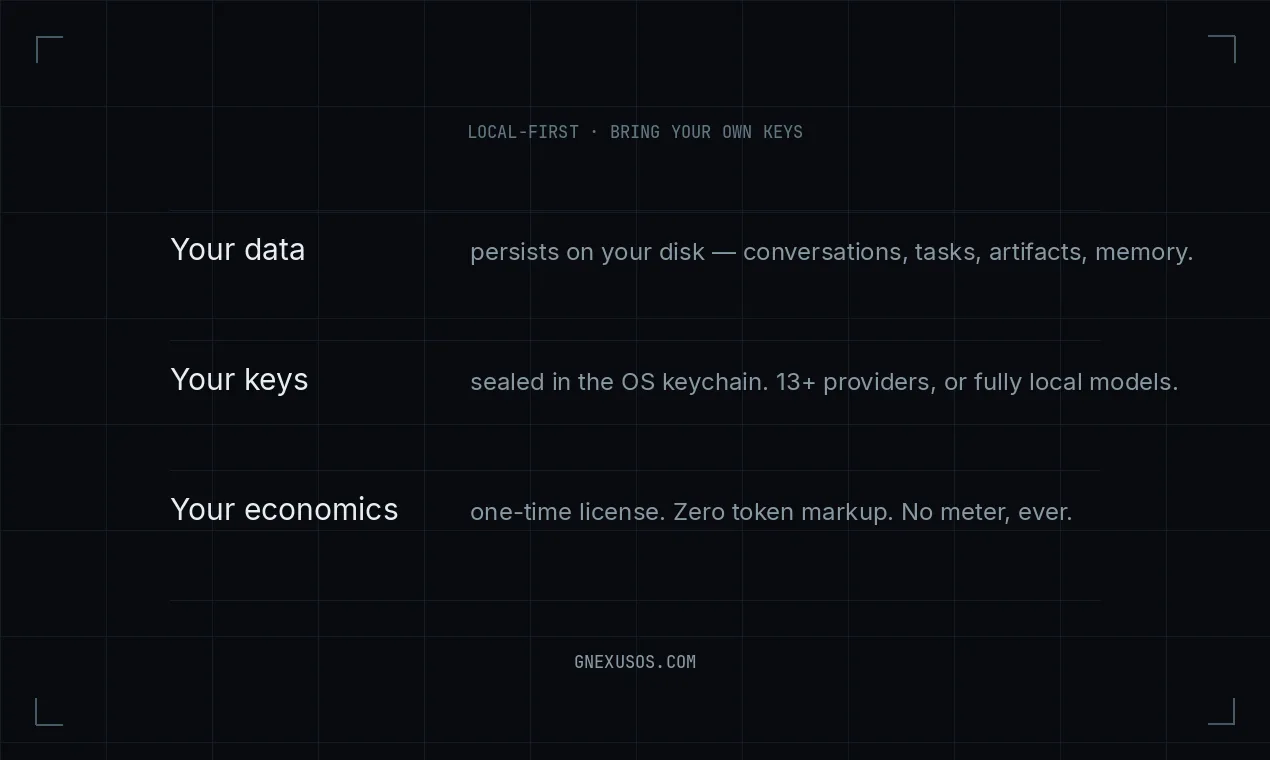
A local-first system inverts the arrangement. Conversations, tasks, artifacts, and memory persist on your own storage. Secrets live in your operating system's keychain, sealed by hardware, not in a vendor's database. Model calls go directly from your machine to the provider you chose, and nothing else leaves unless you say so. The accumulated intelligence about your business accrues to you — where it always should have.
This is not an argument against the cloud as a tool. It is an argument about defaults. A local-first system can reach out — to a model API, a search provider, a service you connected — but every such reach is a decision, made by you, visible in the record. In a cloud-first system, the reaching out is constant, invisible, and not yours to decide.
The economics: stop paying rent on your own workforce
The subscription model for AI tools has quietly recreated the worst deal in software, with a new twist: the meter. A monthly fee for access, then per-task or per-credit charges that scale with exactly the thing you wanted more of — usage. Heavy months cost more. Success costs more. And woven through it all, a markup on the model tokens themselves: the platform buys intelligence wholesale and sells it to you retail, forever.
Bring-your-own-key changes the arithmetic. You hold accounts with the model providers directly — Anthropic, OpenAI, Google, or a dozen others, or fully local models that cost nothing per token — and the platform orchestrating your agents takes no cut of the traffic. You pay providers exactly what providers charge. The orchestration layer you buy once, because software you run on your own machine has no marginal cost worth renting.
Run the numbers on a year of serious agent usage and the conclusion is not close. Rented platforms bill in the thousands, metered against your busiest months. An owned platform on your own keys costs its license once, plus the provider prices you would have paid anyway — without the markup, without the meter, without the anxiety of a usage dashboard.
Ownership used to be the default in software. It still works.
The accountability argument
There is a quieter reason local-first matters for AI agents specifically: verification requires access to ground truth. An agent platform that promises accountability — real checking of what agents claim against what actually happened — needs to see the actual system state: the files, the records, the results. A cloud platform sees only what passes through it. A local platform sits where the truth is.
This is why the trust systems that matter — supervised starts, earned autonomy, evidence-checked completion claims — compose so naturally with local-first architecture. The record of every approval, rejection, and verification lives on your disk, in your format, inspectable forever, exportable always. Accountability that lives in someone else's cloud is accountability you are taking on faith. On your machine, it is just the record.
What to demand from any AI platform
Whether or not you ever run our software, the checklist travels:
Where does my data persist, and can I point to the files. Where do my API keys live, and who else can read them. What does the platform charge on top of provider token prices, and why. What happens to my history if the vendor disappears. And can I verify, from my own records, what my agents actually did.
A local-first platform answers all five with a shrug, because the answers are structural: on your disk, in your keychain, nothing, nothing, and yes.
We built GNexusOS as the full expression of this position — a desktop AI command center where a governed workforce of agents runs entirely on your machine, on your keys, with every claim checked against a record you own. One-time license. No token markup. No meter.
Your machine, under command.